Clouds In a Cup of Joe
Mixing Clouds
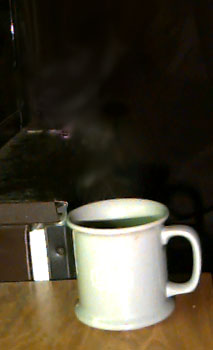
Sitting down to a cup of coffee, like the one pictured above, you may have noticed streams of white clouds billowing from your mug. A question about the source of these clouds might have passed through your mind, only to be answered with an explanation dealing with the warm liquid interacting with the cooler air. But, what really happens to cause these clouds to form?
The roots of cloud formation can be found in the Phase Diagram for Water. This diagram depicts what form, or phase, water will take if kept at a particular temperature and pressure. The diagram has three distinct areas, solid, liquid, and gas, defining the three phases of water.
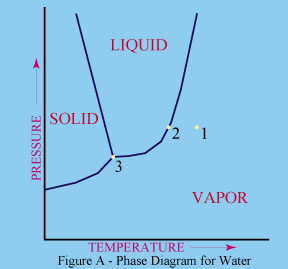 Point 1 on Figure A is a plot of the properties of a parcel that contains water in the gas phase. Intersections of these areas define lines where a parcel would contain the phases of water in the adjoining areas in equilibrium with each other. Point 2 represents a parcel containing both liquid and vapor water- neither is the dominant phase. At one point, the triple point, all phases of water are in equilibrium with each other. This can be seen as Point 3.
Armed with the understanding of the Phase Diagram, the process by which clouds form can be explained. Consider a parcel of water with pressure and temperature properties represented by Point 1 on Figure B. Since Point 1 resides in the vapor area of the diagram, the water within the parcel will be in vapor form. The question is what can happen to this parcel to cause the contained vapor to change to a liquid or solid?
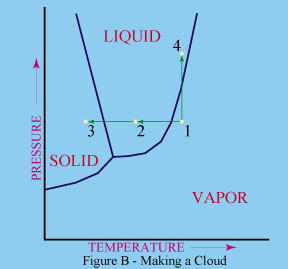 A change that could cause cloud formation is the lowering of the parcel temperature. What happens if the temperature of the vapor is lowered, as shown in Figure B? The vapor will condense to a liquid (Point 2), and, if the temperature is lowered enough, freeze into a solid state (Point 3).
Taking into account the clouds from the coffee mug, can this be the explanation we are looking for? No. A parcel will cool by radiation, conduction, or by expansion. Radiation is not reasonable because of the time scale we are dealing with: The amount of time it takes for a cloud to appear above a mug of hot liquid is fairly minuscule, not nearly enough time for the parcel to cool to the point of cloud formation, especially in all the varying conditions that the cloud formation is observed. Since air is a fairly good insulator, conduction of the heat away from the parcel is not likely. Expansion can be discarded because the environmental pressure is constant in the area around the mug. Alas, the process of cooling the parcel can be ruled out.
Another way to cause the formation of a cloud from the cloudless parcel at Point 1 is to increase the vapor pressure within the parcel (Point 4). How can the pressure exerted by that vapor be increased? One way would be to place the parcel in an environment with a higher pressure. However, this is not a viable option for our cup of coffee- the atmospheric pressure is practically constant in the vicinity of the mug. The only other way to increase pressure would be to increase the amount of vapor in the parcel. This can be accomplished with evaporation of water into the parcel. There is a problem with this option though: As the rate of evaporation into the parcel increases, the rate of condensation increases also. Eventually, the parcel will reach a point where the evaporation rate and condensation rate are equal; the net moisture content of the parcel will remain constant. As Point 2 on Figure A shows, this equilibrium occurs at the border between the vapor and liquid phases- in effect, no cloud will form.
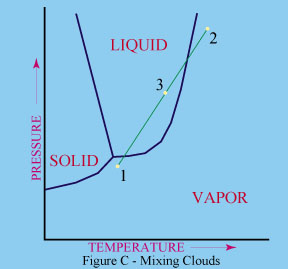 What else can cause cloud formation? Consider two parcels of vapor, one warm and moist, the other cold and dry. If you mix them, you would expect to end up with a parcel with a weighted average of the temperatures and the moisture contents. On the Phase Diagram, as shown on Figure C, the properties of the new parcel will reside on a line connecting the two original parcel plots. The exact position of the plot of the new parcel will vary depending on the temperatures, pressures, and sizes of the original parcels. If the new parcel plot is in the liquid or solid area of the plot, a clouds will form.
How does this relate to the clouds emanating from the coffee cup? What happens is a thin layer of warm, moist vapor is created just above the surface of the liquid by evaporation. This layer is then mixed by surrounding turbulence with cooler, drier parcels from the environment. The result is a parcel with properties that lie within the liquid area of the Phase Diagram (See Figure C). Hence, the rising cloud from your morning cup of coffee.
In our fast-paced lives, it is sometimes easy to ignore the complex physical processes that churn away continuously. Clouds in particular may seem far removed from our lives- they are placed high in the sky, away from our everyone except for those few that pilot through them. It is surprising to many that the complex processes that drive cloud formation and the weather can be as close as their morning cup of coffee.
Craig F. Bohren, Johannes Verlinde, Atmospheric Thermodynamics Classnotes (University Park, PA, ©1993-1994)
Alistair B. Fraser, Meteorological Observations Classnotes (University Park, PA, ©1995)